
The Hidden Language of Consciousness: The Symbol and the Rite as Psychic Technology
Discover how symbols and rituals operate as an ancestral psychic technology. From the mystery of the symbolon and the memento mori skull, to C.G. Jung, the neurobiology of rite, and inner sovereignty.
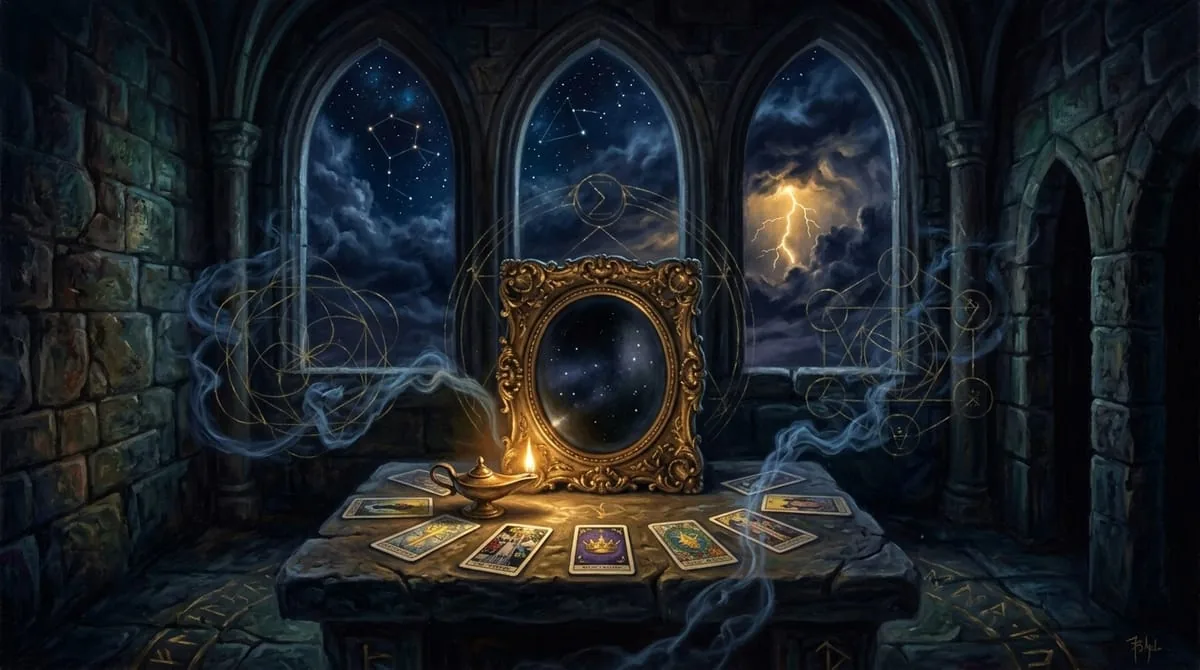
The human intellect tends to compress reality into words, syllogisms, and linear classifications. We have built a world governed by grammatical syntax: subject, verb, and predicate. Yet, in the fertile depths of the psyche lies an ancestral dimension that everyday language cannot map or describe: the territory of the symbol.
Unlike a simple functional sign (such as a traffic marker transmitting a singular, utilitarian command), a symbol condenses multiple layers of meaning into a single visible form. It does not seek to explain an analytical concept; it evokes an inner state, reveals a veiled correspondence, and casts an unbreakable bridge between the visible and the invisible.
Understanding the symbol and its living counterpart—the ritual—is neither an exercise in folkloric archaeology nor a concession to naive superstition: it is the rediscovery of a millennial psychic technology designed to transform human consciousness.
1. What Is the Symbol? The Key Between the Conscious and the Unconscious
Etymologically, the term originates from the Greek symbolon (syn, "together," and ballein, "to throw"): originally denoting a coin, clay tablet, or token broken into two halves between two parties or families. When meeting years later, or across generations, fitting the two halves together instantly authenticated mutual identity and renewed a sacred covenant.
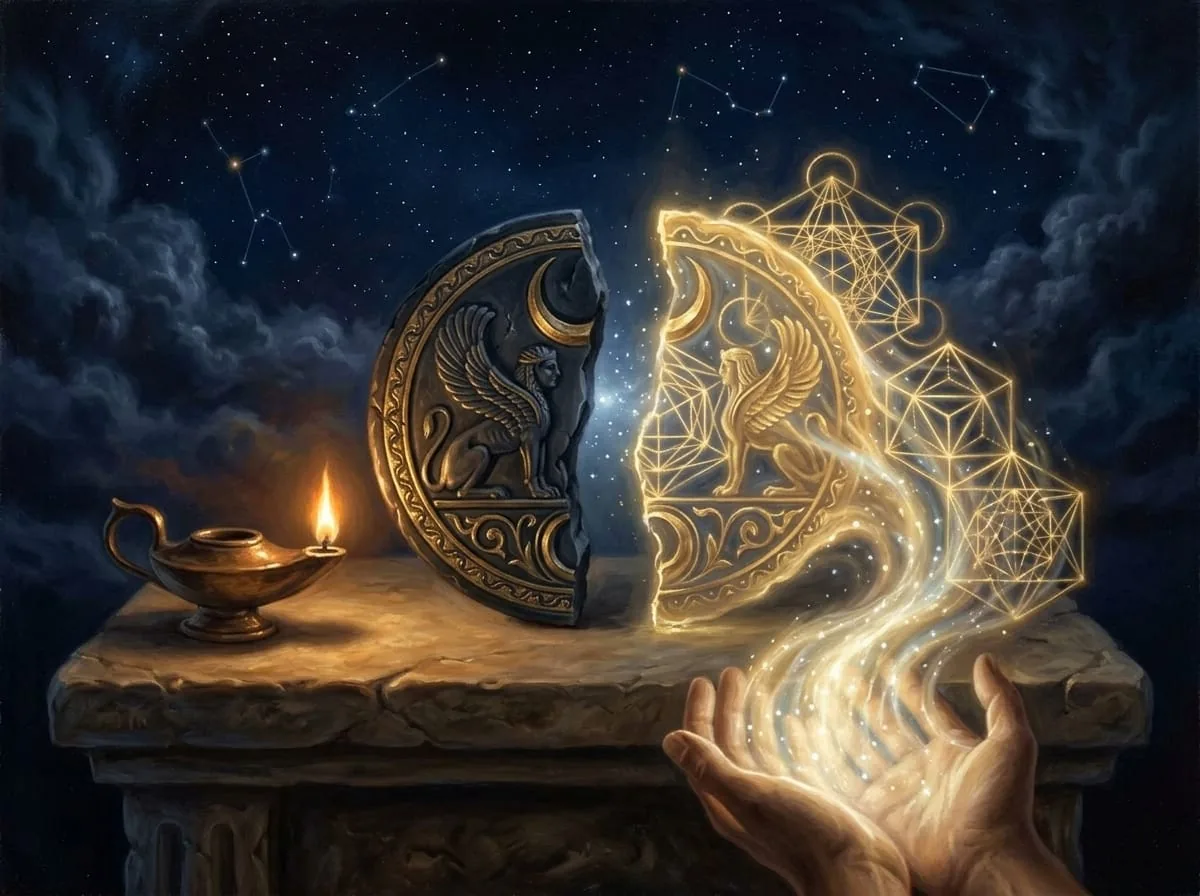
The symbol is, therefore, an intentionally incomplete token of information: an archetypal outer form that only achieves wholeness when unified with the consciousness, memory, and experience of the observer. The symbol does not hand down pre-digested answers; it demands that the seeker contribute their own inner substance to close the circuit.
In the hermetic tradition and depth psychology, the symbol operates through three fundamental principles:
- ✦The sign informs; the symbol transforms: A sign operates in a flat, utilitarian dimension (the word "danger" or a detour arrow). The symbol is dynamic, alive, and multidimensional; it never exhausts its meaning in a static dictionary definition, continuing to unlock deeper perceptual doorways as the observer's awareness matures.
- ✦The vessel of the ineffable: Linear logic relies on the principle of non-contradiction (something is or is not). The symbol, by contrast, is the only vessel capable of holding paradox: life gestating in the womb of death, pure light emerging from primeval darkness, or the cosmic One manifested across the infinite Many.
- ✦The projective mirror: Before a sacred symbol, the mind does not passively memorize external data; it projects upon the image its own emotional condition, unacknowledged fears, and latent aspirations. The symbol functions as a reflective surface where the unconscious reveals itself to the conscious mind.
C.G. Jung, the Archetypes, and the Transcendent Function
It was Carl Gustav Jung who rescued hermetic and alchemical symbolism from modern positivist neglect. Studying clinical fantasies, comparative mythology, and the spontaneous dreams of patients with no occult background, Jung discovered with astonishment that identical geometric motifs, mythological figures, and alchemical emblems recurred with uncanny precision.
He designated these universal matrices as archetypes: a priori patterns of human imagination stored within the collective unconscious.
For Jung, the symbol is not an arbitrary invention of the conscious ego, but the spontaneous fruit of what he termed the transcendent function: the psychic bridge that manifests when the rational mind reaches an impasse and two opposing forces (duty and desire, reason and instinct) enter into civil war within the individual. Unable to resolve the conflict through logical debate, the psyche gestates an integrating image—a living symbol—that reconciles the opposites at a higher order of consciousness.
Through the practice of active imagination, the seeker enters into dialogue with these inner figures, allowing the process of individuation (the journey toward wholeness and self-realization) to unfold without rationalist interference.
2. The Mirror Experiment: What Do You Feel When Beholding This Image?
Pause for a brief moment. Do not analyze. Do not search for scholarly definitions. Simply rest your eyes for three seconds upon the image below:
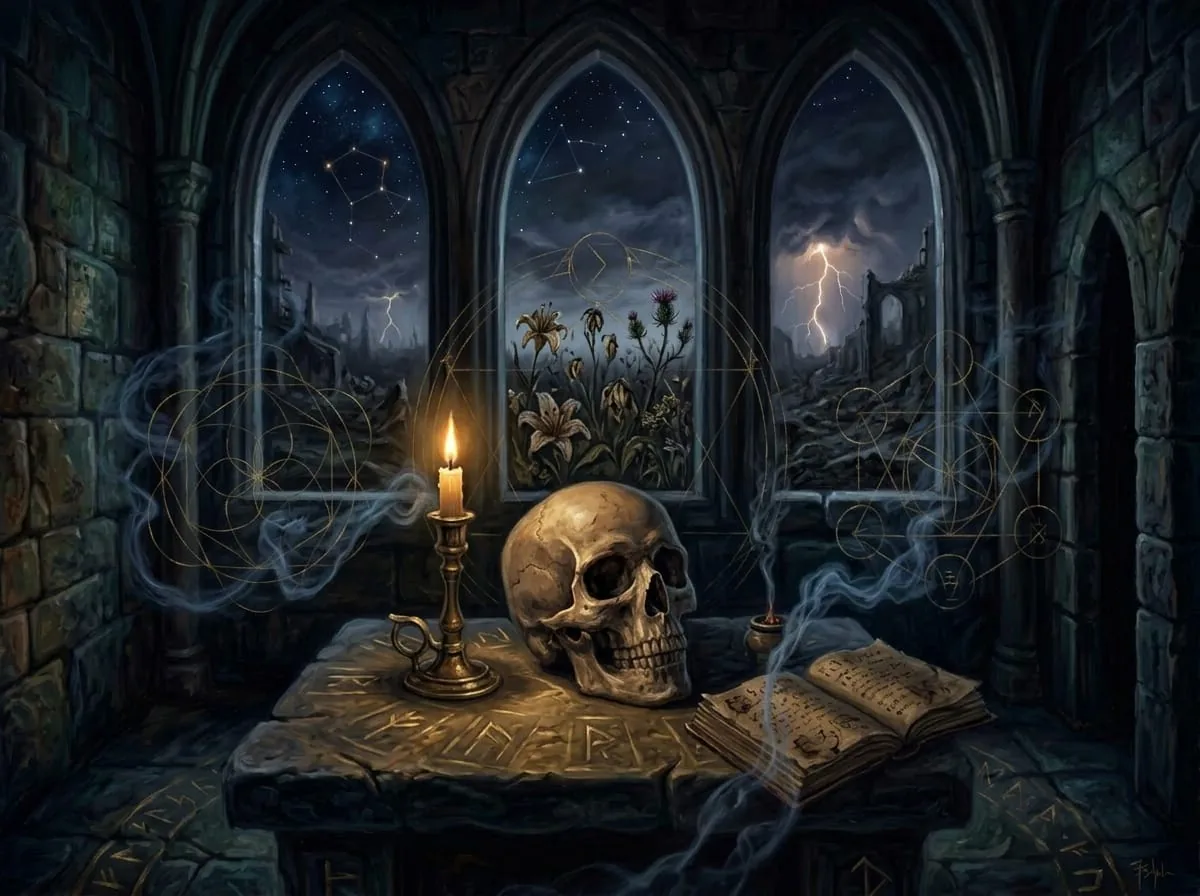
What did your body experience upon seeing it?
If your mind functioned purely as a rational computer, you would have registered a neutral observation: “A bone structure of calcium phosphate devoid of soft tissue, resting beside a burning wax candle and an antique manuscript.”
Yet, it is virtually impossible that you felt only that. In a split second, your nervous system ignited an instinctive, visceral response laden with gravity: danger, mortality, darkness, transience, warning, or quiet mystery.
From Warning Sign to Symbol of Wisdom
This simple exercise demonstrates the living power of the symbol in real time:
- 1The Biological Alarm (The Sign of Danger): At the primal survival layer, the skull is the universal warning sign of fatal peril. It requires no words or spoken language. We see it emblazoned upon poison vials, high-voltage electrical towers, and pirate sails. It delivers an immediate evolutionary imperative: “Halt; here lies the end of life.”
- 2The Initiatic Mirror (Memento Mori): Remove the utilitarian urgency, however, and place the skull within a contemplative sanctuary, and the sign transmutes into Western philosophy’s most profound symbol: the Memento Mori (“Remember that you must die”).
- ✦In Renaissance Vanitas still-life paintings, on the desks of Stoic philosophers, and within the contemplative chamber of ancient mystery schools, the skull does not seek to frighten: it seeks to awaken.
- ✦It reminds the seeker of the futility of egoic vanity, the urgency of purposeful living, and the inevitable dissolution of all worldly masks.
- 3The Alchemical Nigredo: In hermetism, the dissolution of the ordinary state is no tragedy; it is the indispensable first phase of the Great Work (the putrefaction or Nigredo), without which the gold of illuminated awareness cannot be distilled. This is the very secret guarded by Arcanum XIII (Death) in the Tarot: not physical catastrophe, but the necessary scythe that reaps the outworn to inaugurate radical rebirth.
No one had to convince you through intellectual argumentation of what this form represents. Your nervous system, evolutionary memory, and unconscious already possessed the cipher. The symbol simply ignited the flame.
3. History of Symbolism: From Primeval Caves to Hermetism
The use of symbols not only precedes the written word; it marks the primordial dawn of human self-awareness. The symbol was the first instrument through which our ancestors sought to map the cosmos, tame chaos, and understand their place within the universal fabric.
| Era / Tradition | Symbolic Expression | Primary Function |
|---|---|---|
| Paleolithic & Archaic Epochs | Cave paintings, bone spirals, negative handprints, broad-hipped Earth Goddesses. | Mimetic communion with elemental forces, fecundity, and covenant with the animal spirit and the unseen. |
| Egypt & Mesopotamia | Sacred hieroglyphs, the primordial Ouroboros, the Ankh (Key of Life), winged solar disks, ziggurats. | Codification of cosmic laws, navigation of the soul through the underworld (Duat), and the preservation of divine order (Ma'at). |
| Hermetic Tradition & Alchemy | Caduceus of Hermes, the Green Lion devouring the Sun, the Rebis / Alchemical Hermaphrodite, the Chymical Wedding. | Veiled maps of psychological transmutation, spiritual purification, and the union of Heaven (Spirit) and Earth (Matter). |
| Renaissance & Kabbalah | The Tree of Life (Otz Chiim), the ten Sephirot, Planetary Seals, and the 22 Major Arcana of the Tarot. | Masterful visual synthesis of Neoplatonic philosophy, Jewish mysticism, and universal celestial correspondences. |
4. Uses of the Symbol: Navigation, Protection, and Transmutation
Far from being decorative ornaments or esoteric puzzles for an intellectual elite, symbols have always operated as instruments of precision within the inner arts:
- ✦Psychological Cartography: Archetypal traditions organize the vast and turbulent topography of human experience into a codified visual alphabet. They enable the seeker to pinpoint their precise coordinate: whether walking the desert isolation of the Hermit, taking the blind leap of the Fool, or undergoing the structural collapse of the Tower.
- ✦Focus and Anchoring of Will: In hermetic practice, mental dispersion is the primary obstacle. Focusing attention and contemplation upon a sacred symbol (a yantra, a planetary seal, or a ceremonial card) stills the chatter of the ego and attunes consciousness to a single vibratory frequency, polarizing the operator’s will.
- ✦Immortal Preservation of Knowledge: Empires crumble, languages go extinct, and manuscripts are burned by conquerors or distorted by careless copyists. The symbol, however, is immune to temporal decay: it travels through millennia intact, revealing its inner secrets only to those who possess the internal key to decode it.
The Tarot as an Alphabet of Living Symbols
Among the symbolic systems of the Western esoteric current, the Tarot stands as an architectural summit. It is no carnival deck for predicting petty fortunes; it is an ecosystem of living archetypal mirrors.
Every Major Arcanum embodies an intricate web of astronomical, alchemical, kabbalistic, and chromatic correspondences. When a seeker approaches a reading in a consecrated atmosphere, the hermetic principle of correspondence manifests directly: “As above, so below; as within, so without.”
Through the shuffling and laying out of cards, what Jung and physicist Wolfgang Pauli termed Synchronicity takes center stage: a meaningful, acausal coincidence between an inner psychological condition and an outer physical occurrence. The cards do not dictate a fatalistic future; they illuminate the energetic configuration and blind spots of the unconscious.
The Tarot operates as the quintessential symbolon: it brings the conscious inquiry together with its hidden root, returning sovereign clarity to the seeker's choices.
5. The Ritual: The Symbol Put into Action
A symbol contemplated merely within the pages of a book remains an intellectual abstraction. The ritual is the symbol set into motion: the sacred drama that embodies the archetype and anchors it directly into material reality.
Human transformation does not occur through detached intellectual analysis alone. No deep wound is healed nor deeply rooted habit broken by simply agreeing with a logical argument. Transformation requires somatic experience. The ritual takes the abstraction of the idea and imbues it with three indispensable dimensions:
- 1Consecrated Space and Time (Temenos): The rite carves an inviolable perimeter apart from mundane existence (the magic circle, the lighting of the lamp, the striking of a bell). Within that boundary, ordinary haste and social demands are suspended; one enters mythic time.
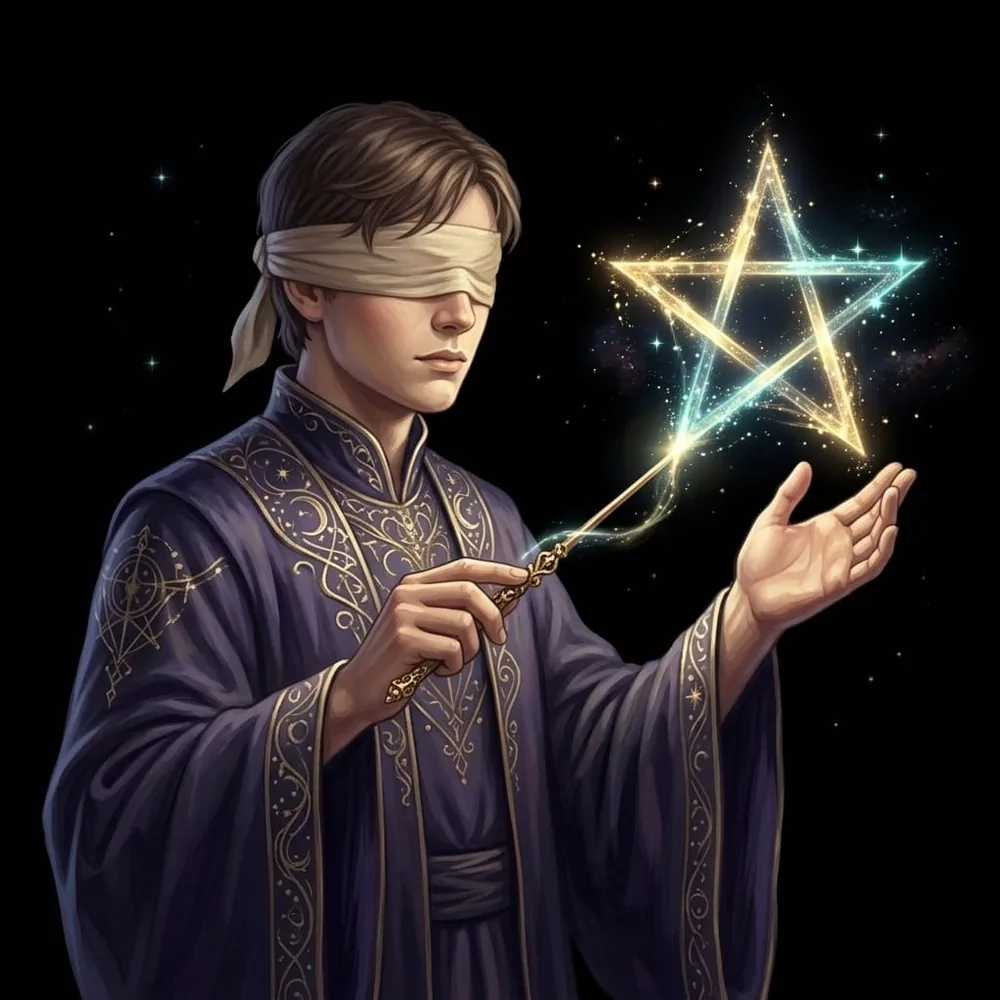
- 2Gesture and Word of Power (Actus Solemnis): The entire physical body participates. As in the Golden Dawn tradition of tracing the Banishing Pentagram in the air with a ceremonial wand, the physical movement of the arm and the vibration of the spoken word carve invisible yet psychically tangible geometries. The body ratifies the intent.
- 3The Somatic Reality Check: For the evolutionary core of the brain, the boundary between a solemnly enacted metaphor and a physical event is virtually non-existent. Witnessing fire consume the token of an outworn vow signals to the psychic apparatus that the threshold has been crossed irrevocably.
Neurobiology and the Somatosensory Dimension of Rite
The effectiveness of ritual requires no naive occult credulity: it is grounded in human neurophysiology.
The human brain does not process experience through a singular channel. While the prefrontal cortex mediates verbal reasoning, planning, and analytical critique, the limbic system (home to deep-seated emotions, attachments, and traumas) and subcortical networks communicate primarily through bodily sensations, visual forms, scents, and rhythms.
When an individual engages in ritual action:
- ✦Polysensory Engagement: The fragrance of incense, the flicker of candlelight, the physical tactile engagement, and the rhythmic resonance of the voice saturate sensory pathways, shifting brainwave patterns toward alpha and theta states.
- ✦Modulation of the Amygdala: During periods of grief, upheaval, or ending, the amygdala maintains a hypervigilant alarm cycle. A ritual structured with an opening, climax, and formal closure delivers an unambiguous somatic signal to the nervous system: the crisis has been acknowledged, ordered, and contained.
- ✦Consolidation into Episodic Memory: A purely conceptual intention often evaporates under social pressures. In contrast, an action enacted with deliberate physical ceremony is forged into neural networks as a salient episodic memory—a resilient somatosensory anchor to which the individual can return whenever resolve wavers.
6. Psychic Effects and Contemporary Applications
When the symbol is awakened through conscious rite, profound recalibrations occur within the modern psyche:
- ✦Integration of Polarities (Coincidentia Oppositorum): Reconciles inner forces that the ego views as incompatible: strength and vulnerability, analytical intellect and visceral instinct. The unitive symbol embraces both without amputating either.
- ✦Sacred Transgression and the Covenant: Historical initiations and mystery schools utilized rites of death and rebirth to seal unbreakable commitments. The rational mind easily rationalizes away a contract signed on cold paper; yet it finds it extraordinarily difficult to violate a covenant sworn before sacred fire and ratified through a collective archetype.
- ✦Somatic Resolution of Stagnation and Grief: Many modern neuroses are, at heart, frustrated rites of passage—adults psychologically bound to parental expectations, or trapped in relationships that dissolved years ago. Enacting an intentional symbolic closure (cutting a binding cord, returning ashes to the soil) grants the psyche the catharsis that talk therapy often takes years to crystallize.
7. Living Examples of the Symbol
To understand this technology in concrete practice, consider three of the most universal archetypes in the hermetic corpus:
The Ouroboros (The Serpent Devouring Its Tail)
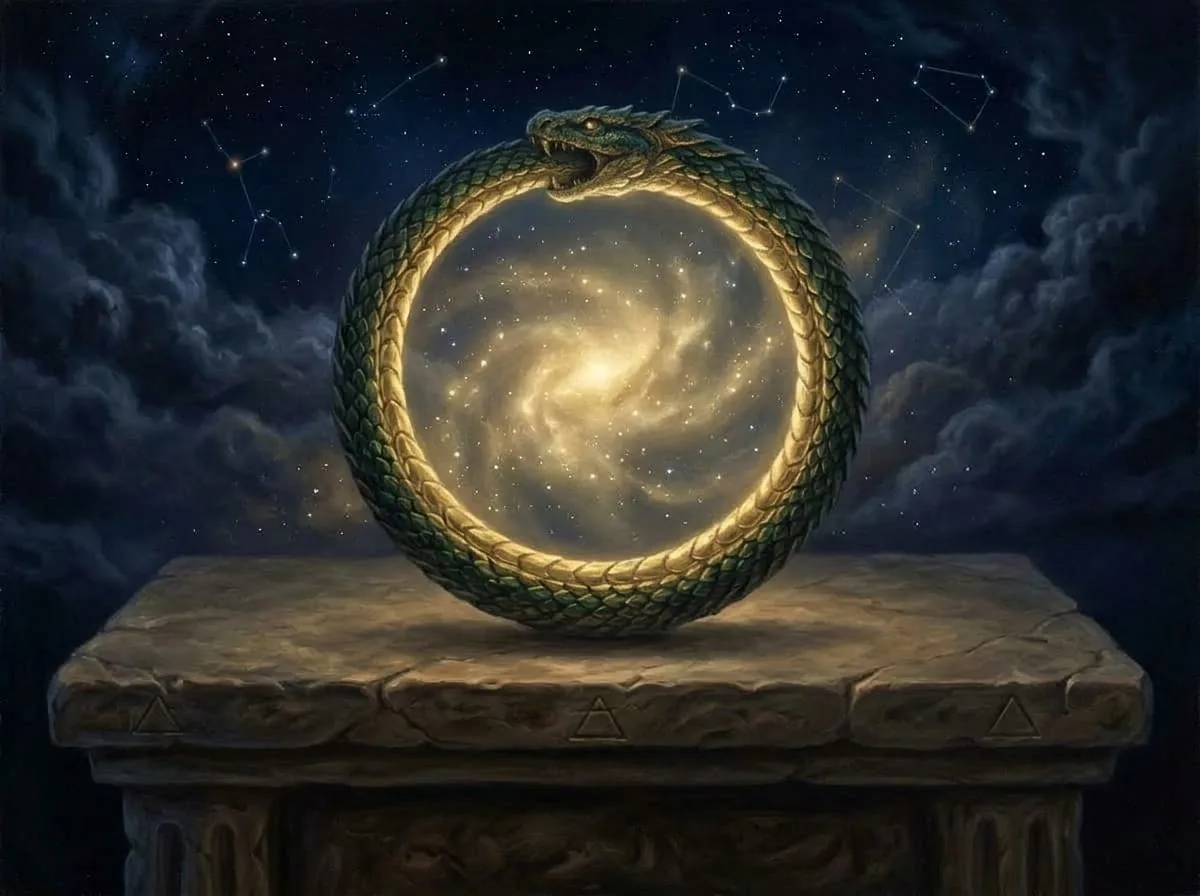
Present from ancient Egyptian funerary papyri to Alexandrian alchemical manuscripts, the Ouroboros embodies the cyclical perpetuity of the cosmos: eternal return, primordial totality, and the self-sufficient vitality of the Whole (Hen to Pan, "All is One").
In inner work, the Ouroboros stands as the remedy for despair: it reminds the wanderer that every apparent destruction carries within its core the germ of the next renewal. Nothing is lost; energy merely shifts form.
The Caduceus of Hermes

A golden rod crowned with wings and symmetrically embraced by two serpents coiling in a double helix. Far from symbolizing mere medicine or commerce, the Caduceus is the technical diagram of the opposing currents of Creation:
- ✦The twin serpents represent the antagonistic polarities of existence (active and receptive, sulfur and mercury, solar and lunar, Ida and Pingala in yogic tradition).
- ✦The central shaft represents the axis of awakeness (Sushumna), the unmoved channel of presence.
- ✦The outspread wings mark spiritual liberation: consciousness that destroys neither polarity, but rides in dynamic equilibrium between them.
The Tower (Arcanum XVI of the Tarot)
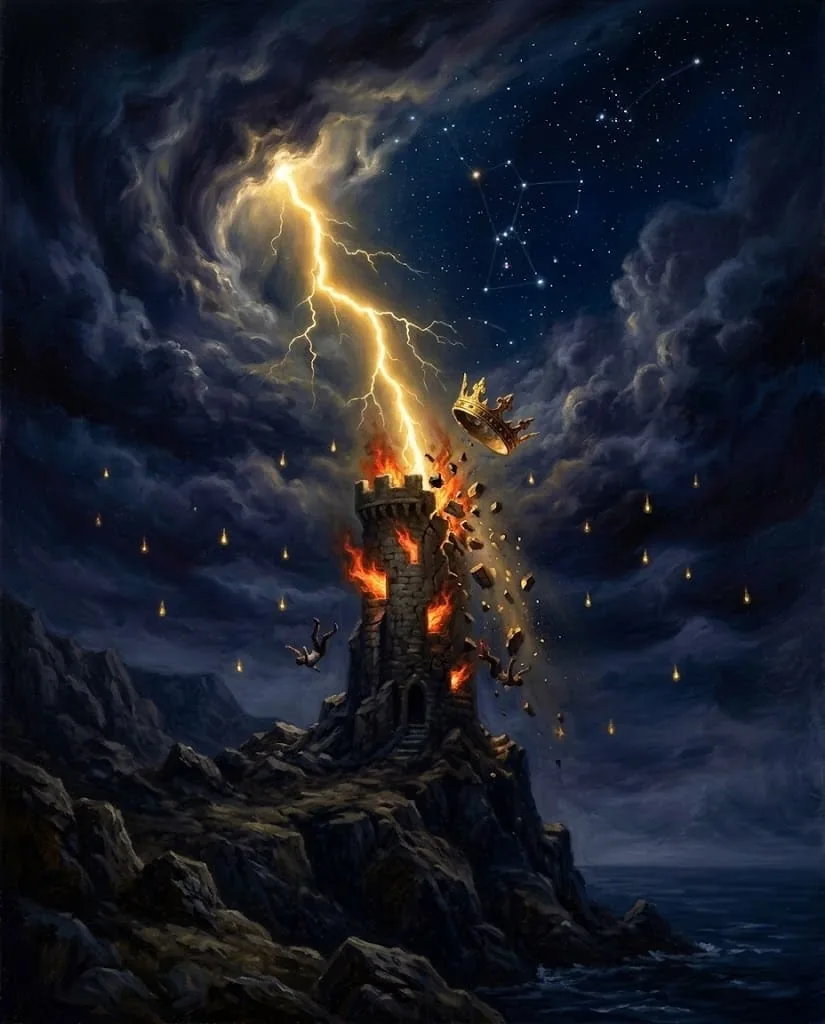
A stone fortress perched upon a craggy pinnacle, its crown blasted by divine celestial lightning, casting its dwellers into the void amidst purifying flame.
The Tower does not herald arbitrary calamity; it describes the necessary demolition of rigid egoic edifices constructed to insulate the self from reality. The lightning is no adversary: it is the sudden, uncompromising breakthrough of Truth. Terrifying though the fall may be, the collapse of artificial ramparts is the only path through which the seeker returns to bare soil, gazing unhindered upon the open sky.
8. Practical Guide: The Lucid Rite in Daily Life
How can modern seekers harness the power of ritual without succumbing to empty dogma or performative superficiality? Through the lucid rite: a deliberate, sober, and conscious act where the operator claims full psychological authorship.
To close an emotional chapter, release an outworn belief, or inaugurate a new commitment, follow this four-phase protocol:
- 1Symbolic Condensation (The Prima Materia): Clearly define the state you wish to transmute. Avoid vague abstractions: identify a tangible object that embodies that reality (a cord representing an attachment, a handwritten declaration in black ink, a heavy stone carrying the weight of old regret). You have fashioned your symbolon.
- 2Opening the Threshold (Delimiting the Sacred): Choose a secluded space free from distraction. Mark the boundary sensorially: dim artificial lights, ignite a single candle, and take three deep breaths with closed eyes. Declare internally or aloud: “In this space and hour, mundane time is stilled; I claim my inner authority.”
- 3The Irrevocable Physical Act (The Somatic Climax): Execute the physical action with unhurried presence. If letting go, sever the cord with a single cut; if closing a chapter, surrender the parchment to the flame and watch words turn to gray ash; if planting a new initiative, bury a seed in moist soil. The body must feel the finality.
- 4Closure and Silence (Integration): Extinguish the flame without blowing it out, acknowledge the lesson of the past cycle, and depart the space without lingering or looking back. The golden hermetic rule following ritual is Silence: do not dissect the act with others or ruminate in doubt. Allow the unconscious to integrate the transformation in deep stillness.
9. Synthesis: The Symbol as Technology of Sovereignty
We inhabit a culture inundated with raw information yet impoverished of meaning. We are conditioned to believe that mind equals utilitarian calculation, and that symbolic awareness belongs to childish fantasy.
Nothing could be further from the truth. The symbol is the native dialect of human consciousness. When we disown symbols, we do not become purely rational; we simply become unconscious captives of unexamined symbols: commercial logos, political slogans, and fear-based media narratives.
Ritual and symbol, practiced with lucidity and inner discipline, are instruments of personal sovereignty. They allow the individual to reclaim the throne of their psychic realm, cleanse the temple of memory, and step forward as the conscious architect of their own path.
Those who master the secret language of the symbol cease to be passive marionettes of circumstance, speaking face-to-face with the deeper currents of the soul and the cosmos.
10. Bibliographic References and Recommended Reading
For seekers and scholars wishing to explore the theoretical, typographic, psychological, and esoteric roots of the symbol and ritual:
- ✦Adrian Frutiger — *Signs and Symbols: Their Design and Meaning
A masterwork on sign morphology and graphic geometry. Frutiger meticulously analyzes the transition from primeval mark and cross to esoteric sigils, illuminating the interplay between figure and ground, positive and negative white signs radiating against black space, and how human consciousness confers spiritual resonance upon elementary forms.
- ✦Carl Gustav Jung — *The Red Book (Liber Novus)
Jung’s most personal visionary chronicle. Born of his deliberate descent into the unconscious via active imagination, this illuminated manuscript documents firsthand encounters with archetypal figures (Philemon, Elijah, Salome) and the spontaneous birth of unitive symbols preceding his formal clinical theories.
- ✦Carl Gustav Jung (ed.) — *Man and His Symbols
The final work conceived and overseen by Jung prior to his death, tailored for the general reader. An indispensable gateway into dream language, the transcendent function, and the vital human need for living symbols.
- ✦Mircea Eliade — *The Sacred and the Profane: The Nature of Religion
The foundational text of comparative religion. Eliade articulates the rupture of mundane homogeneity through the erection of the temenos (sacred center) and the return to illo tempore (mythic primordial time) through ritual enactment.
- ✦Israel Regardie — *The Tree of Life: A Study in Hermetic Magic
One of the clearest expositions of ceremonial technique from the Hermetic Order of the Golden Dawn, detailing the somatic and psychic mechanics of sacred geometry in motion (such as the Lesser Banishing Ritual of the Pentagram).
- ✦Manly P. Hall — *The Secret Teachings of All Ages
A monumental compendium of hermetic, kabbalistic, and esoteric lore, essential for mapping the universal emblems that have guided seekers throughout human history.
- ✦Joseph Campbell — The Power of Myth (with Bill Moyers)
An inspiring dialogue illustrating why human culture cannot survive without myth, and how rites of passage provide the ancestral scaffolding for life's great internal transitions.