
The Oracle: History, Mystery, and the Illusion of Fate
Explore the ancient oracles of Delphi, the cautionary tale of King Croesus, modern psychological oracles, their perils, and why, in the end, human choice remains sovereign.
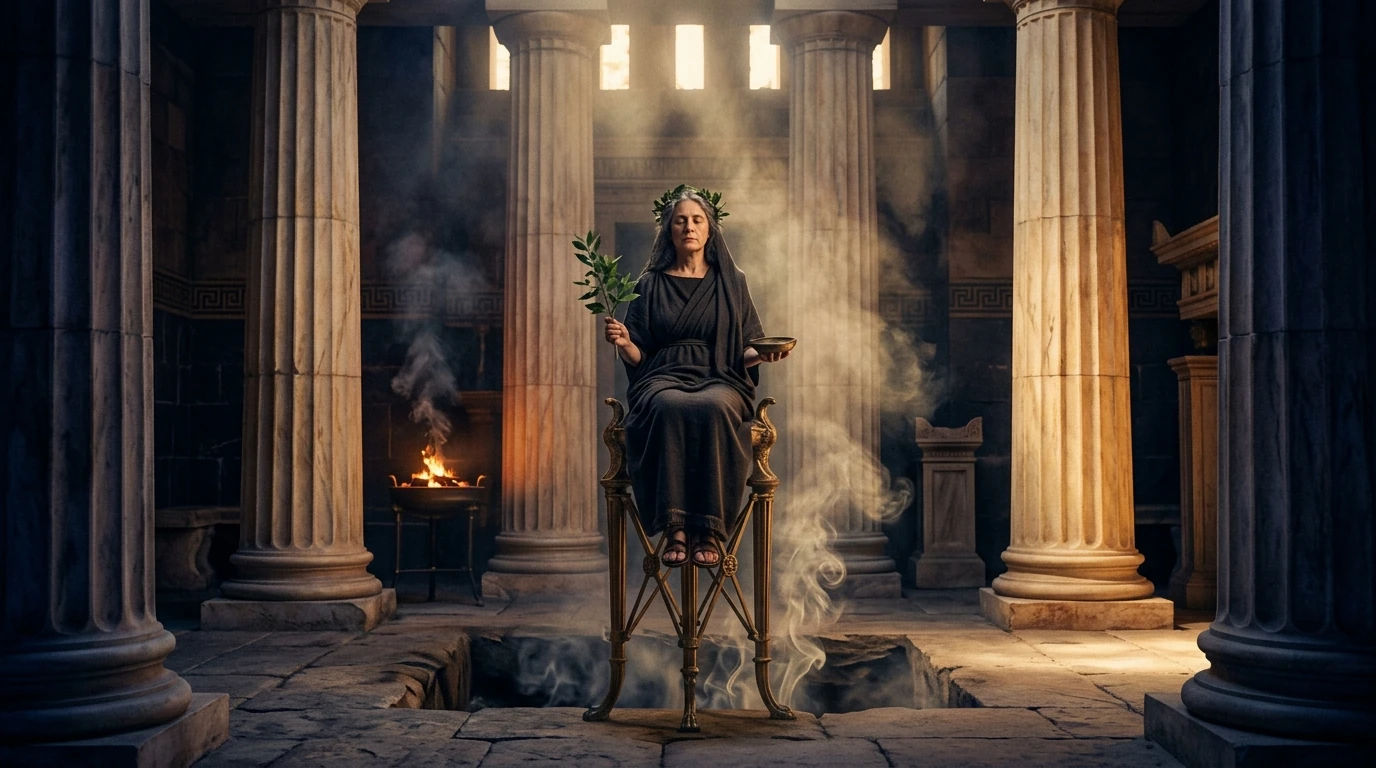
Ever since humanity built its first fires against the primeval dark, a solitary question has echoed through the human heart: “What awaits me tomorrow?”. Uncertainty is the inseparable companion of human existence. Faced with the fog of the future, ancient civilizations turned neither to statistical models nor to algorithmic forecasts; they journeyed to the Oracle.
For millennia, oracles determined the fall of dynasties, the waging of wars, and the birth of empires. In today's hyper-connected, secular world, oracles have not vanished: they have simply shed their skin, migrating from subterranean stone sanctuaries to glowing digital screens.
Yet, what exactly is an oracle? How did these institutions operate in antiquity? What was the fatal trap into which emperors and kings repeatedly stumbled when consulting them? And above all: why does the final verdict—despite all prophetic insight—always belong to human free will?
1. What Is an Oracle? Beyond Mere Fortune-Telling
The word oracle derives from the Latin oraculum, which stems from the verb orare (to speak, petition, or plead). In its etymological and philosophical foundations, an oracle encompasses three intertwined dimensions:
- 1The Response: The message, counsel, or insight delivered from a transcendent or deeper source.
- 2The Medium or Spokesperson: The priestess, seer, shaman, or prophet who channels the transmission.
- 3The Sacred Precinct: The geographic sanctuary—the temenos—where the veil between the mundane and the unseen was believed to thin.
Unlike the carnival fortune-teller promising neat certainties, the authentic oracle was never a mechanical predictive machine. Its quintessential function was to serve as a hermeneutic bridge: a symbolic apparatus that brought the seeker’s finite conscious mind into dialogue with the wider cosmic order or the fertile depths of the collective psyche.
2. History and Cultural Significance of Ancient Oracles
In Classical Greece, the oracle was far from a superstitious novelty; it was the moral and geopolitical axis of the Mediterranean basin. No monarch marched to war, no lawmaker ratified a constitution, and no expedition set sail to found a colony without first soliciting oracular counsel.
The Navel of the Earth: The Temple of Apollo at Delphi
Perched along the dramatic cliffs of Mount Parnassus stood the Sanctuary of Delphi, revered by the Hellenic world as the Omphalos—the literal navel of the world. There, the Pythia, a peasant woman chosen for her spiritual purity, bathed in the sacred Castalian Spring, chewed laurel leaves, and sat atop a high bronze tripod suspended over a rock fissure (chasma) emitting subterranean vapors.
In an altered state of inspiration, the Pythia spoke in enigmatic, poetic fragments, which temple priests transcribed into elegant hexameter verse before handing them to the petitioner.
“Know thyself, and nothing in excess.”
These two immortal maxims—Nosce Te Ipsum and Meden Agan—were carved into the very stone of Apollo’s temple entrance. They were not casual philosophical ornaments; they were the operating instructions for the oracle itself. The god warned every pilgrim that an external answer is utterly worthless if the seeker lacks the courage to examine their own mind.
Sacred Voices Across Civilizations
- ✦Dodona (Greece): The oldest sanctuary dedicated to Zeus, where priests interpreted the rustling leaves of a sacred oak tree and the flight of doves.
- ✦The Oracle of Ammon at Siwa (Egypt): Nestled deep within the Libyan desert sands, so renowned that Alexander the Great rode through brutal dunes for weeks to be acknowledged by its priests as the son of Amun.
- ✦The I Ching (China): The three-thousand-year-old Book of Changes. By casting yarrow stalks or copper coins, this philosophical oracle invokes not personal deities, but the dynamic cosmic flow of the Tao and the perpetual dance between Yin and Yang.
3. The Cautionary Tale of King Croesus: The Paradox of Interpretation
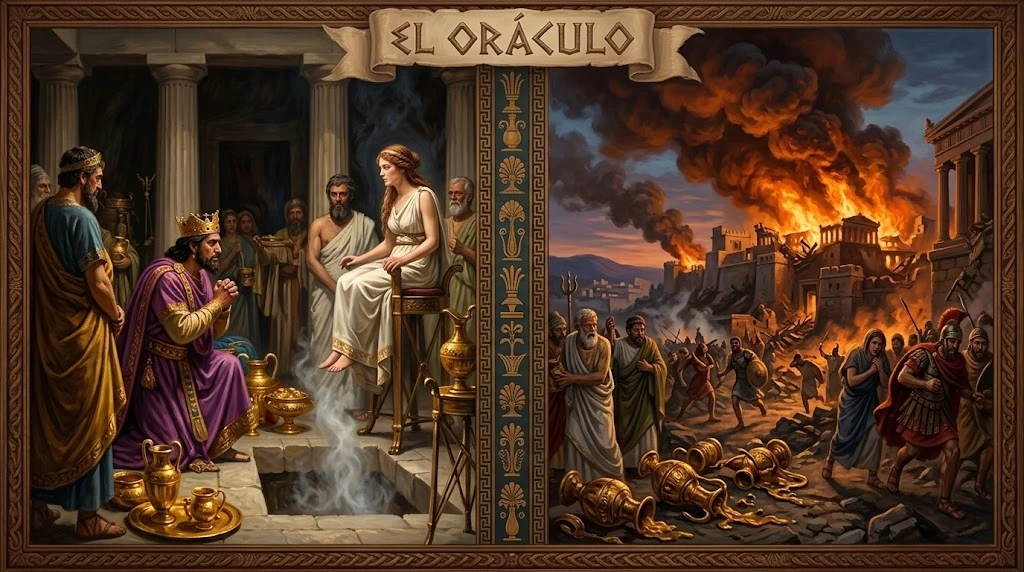
If there is one historical account that crystallizes the true nature of oracles—and the perilous blindness of the human ego—it is the saga of King Croesus of Lydia (6th century BCE), recorded by the historian Herodotus.
Croesus was the wealthiest ruler of his age, commanding an opulent and formidable kingdom. Alarmed by the meteoric rise of the Persian Empire under Cyrus the Great, Croesus resolved to launch a preemptive strike. Before mobilizing his legions, he sent lavish diplomatic gifts of solid gold to the Delphic Pythia, posing a singular question:
“Should King Croesus cross the River Halys and wage war against the Persians?”
After the solemn sacrifices, the Pythia delivered one of the most celebrated pronouncements in world history:
“If Croesus crosses the River Halys, he will destroy a great empire.”
Drunk on imperial hubris, Croesus celebrated the prophecy as divine validation. He rallied his forces, crossed the border river, and marched boldly into Persian territory.
The result was an unmitigated catastrophe. The Lydian army was annihilated; Sardis, its glittering capital, was stormed and sacked; and Croesus himself was captured in iron chains by Cyrus’s troops.
Bound upon a funeral pyre, Croesus wept bitterly, cursing Apollo for betraying his most devoted patron. When Cyrus heard this lament, he permitted Croesus to send envoys back to Delphi to demand why the god had deceived him. The oracle’s reply remains timeless:
“Apollo spoke the truth. The god proclaimed that if you crossed the River Halys, you would destroy a great empire. And so you did: you destroyed your own. Had you been wise, you would have asked which empire the god meant.”
This ancient episode reveals the core truth of every oracular encounter: the symbol does not fail; it is the self-absorbed wishful thinking of the seeker that misinterprets the sign, hearing only what it desires to hear.
4. Modern Oracles: From Stone to Silicon
In the 21st century, the human thirst for perspective has not diminished in the slightest. The medium, however, has evolved:
- ✦Tarot and Archetypal Decks: Unlike fatalistic medieval prophecies, modern decks align with Carl Jung’s archetypal psychology. The contemporary oracle is not a distant mountaintop shrine, but a portable deck of 78 symbolic mirrors designed for honest dialogue with the subconscious.
- ✦The Principle of Synchronicity: Rather than supernatural causation, we understand oracular inquiry through synchronicity: meaningful, non-causal coincidences where an ostensibly random symbol resonates with surgical precision against the querent’s inner dilemmas.
- ✦Digital Interfaces and AI: Today, algorithms and web applications process oracular frameworks with unprecedented immediacy. A click on a smartphone simulates the casting of ancient runes or I Ching coins, delivering instant, reflective prompts in seconds.
5. The Perils of the Oracle: When Inquiry Becomes a Prison
Consulting an oracle can be an enlightening contemplative practice, yet it harbors distinct psychological traps when critical thinking is abandoned:
| Psychological Hazard | Underlying Mechanism | Real-World Consequence |
|---|---|---|
| Analysis Paralysis | Chronic fear of making autonomous choices | Inability to act without first "pulling a card" or consulting a binary answer |
| Abdication of Agency | Externalization of the locus of control | Blaming cards, cosmic fate, or the stars for personal errors and inaction |
| Confirmation Bias | Desperately seeking validation for pre-existing desires | Disregarding glaring warning signs and rushing into avoidable catastrophes like King Croesus |
| Self-Fulfilling Prophecy | Dogmatic belief in a grim forecast | Unconsciously altering behavior until the anticipated misfortune is manifested |
The oracle must always serve as a lighthouse in the fog, never the captain of the vessel. Anyone who abdicates their power of decision to a card or an algorithm becomes the willing prisoner of their own insecurity.
6. Conclusion: In the End, the Human Being Decides
The greatest secret of ancient and modern oracles alike lies not in an ability to foretell what will happen, but in their capacity to reveal who is asking.
When you toss a coin into the air to choose between two conflicting paths, in that brief second while the coin spins suspended against the sky, your heart already knows which side it hopes will land face up. The oracle operates on precisely the same principle: it is a psychological catalyst accelerating your own inner clarity.
Cards, hexagrams, and archetypes can illuminate currents, point out hidden reefs, and remind you of inner reserves you had forgotten. But no sacred stone, no trance-bound priestess, and no digital algorithm will ever walk the path on your behalf.
In the end, the human being is the only one who decides.
The River Halys lies before you. Whether to cross it or remain on the shore will never be an irreversible decree of the gods—it is, and will always be, your own sovereign choice.
Consult the Mirror: Experience the Live Oracle
Do you have a specific question weighing on your mind? A dilemma hovering between two choices? We invite you to consult our interactive oracle:
👉 Enter and Consult the Yes / No / Maybe Oracle ↗
Take a slow, deep breath, hold your question with quiet focus, and remember: the response you receive is not a decree, but a spark to illuminate your own discernment.
Sources & Scholarly References
For further reading on the historical and psychological study of oracles:
- ✦Herodotus (c. 484–425 BCE) — The Histories (Book I: Clio, 46–54 & 86–91). The foundational historical account of King Croesus of Lydia, the Delphic Pythia, and the fall of Sardis.
- ✦Plutarch (c. 46–120 CE) — Moralia: De Pythiae oraculis (On the Oracles of the Pythia) & De defectu oraculorum (On the Obsolescence of Oracles). Treatises written during Plutarch's thirty years serving as a priest of Apollo at Delphi.
- ✦Carl Gustav Jung (1952) — Synchronicity: An Acausal Connecting Principle (Collected Works, Vol. 8). The psychological foundation of oracles as archetypal mirrors of the unconscious.
- ✦Joseph Campbell (1949) — The Hero with a Thousand Faces. Mythological mapping of the descent into oracular insight.
- ✦Richard Wilhelm & C.G. Jung (1950) — The I Ching or Book of Changes. Classical translation with Jung's famous foreword on the psychology of oracular consultation.